(VN)+84.387.285.099
  m.me/VietnamVisaservice
  Vietnamvisa
  Vietnamvisa



From September 11, 2026, Apostille can be used for eligible public documents moving between Vietnam and a Contracting Party where the Convention applies in relation to Vietnam. A valid Apostille replaces consular legalization for that document. It does not confirm the document’s content, and translation or subject-specific requirements may still apply.
Vietnam deposited its instrument of accession to the 1961 Hague Apostille Convention on December 31, 2025. The Convention takes effect for Vietnam on September 11, 2026. This changes the route for many public documents used across borders, but it does not mean that every document or every country relationship automatically qualifies.
Key points
- Apostille applies to public documents, not automatically to every private document created by an individual or company.
- The country where the document was issued and the country where it will be used must have an applicable Convention relationship.
- For eligible foreign public documents used in Vietnam, a valid Apostille removes the Vietnamese consular legalization step.
- Foreign-language documents generally must be translated into Vietnamese, with the translation notarized or certified, unless specialized law provides otherwise.
- Germany, Austria and Czechia have objected to Vietnam’s accession, so the Convention does not apply between Vietnam and those countries unless that status changes.
- Always verify the country status, competent authority and receiving agency’s subject-specific requirements before filing.
1. What is Apostille?
An Apostille is a certificate issued under the Hague Convention of 5 October 1961 Abolishing the Requirement of Legalisation for Foreign Public Documents. It simplifies the authentication of an eligible public document for use in another country where the Convention applies.
It confirms the origin of a public document, including the authenticity of the signature, the capacity or official position of the signer, and the seal or stamp on the document where applicable.
Note: An Apostille does not certify that the statements inside the document are true, does not approve the document’s content, and does not guarantee that a receiving authority will accept it for every legal purpose.
When a document is sealed with an Apostille stamp, it can be used in one of the Hague Convention countries without carrying out any further acts.
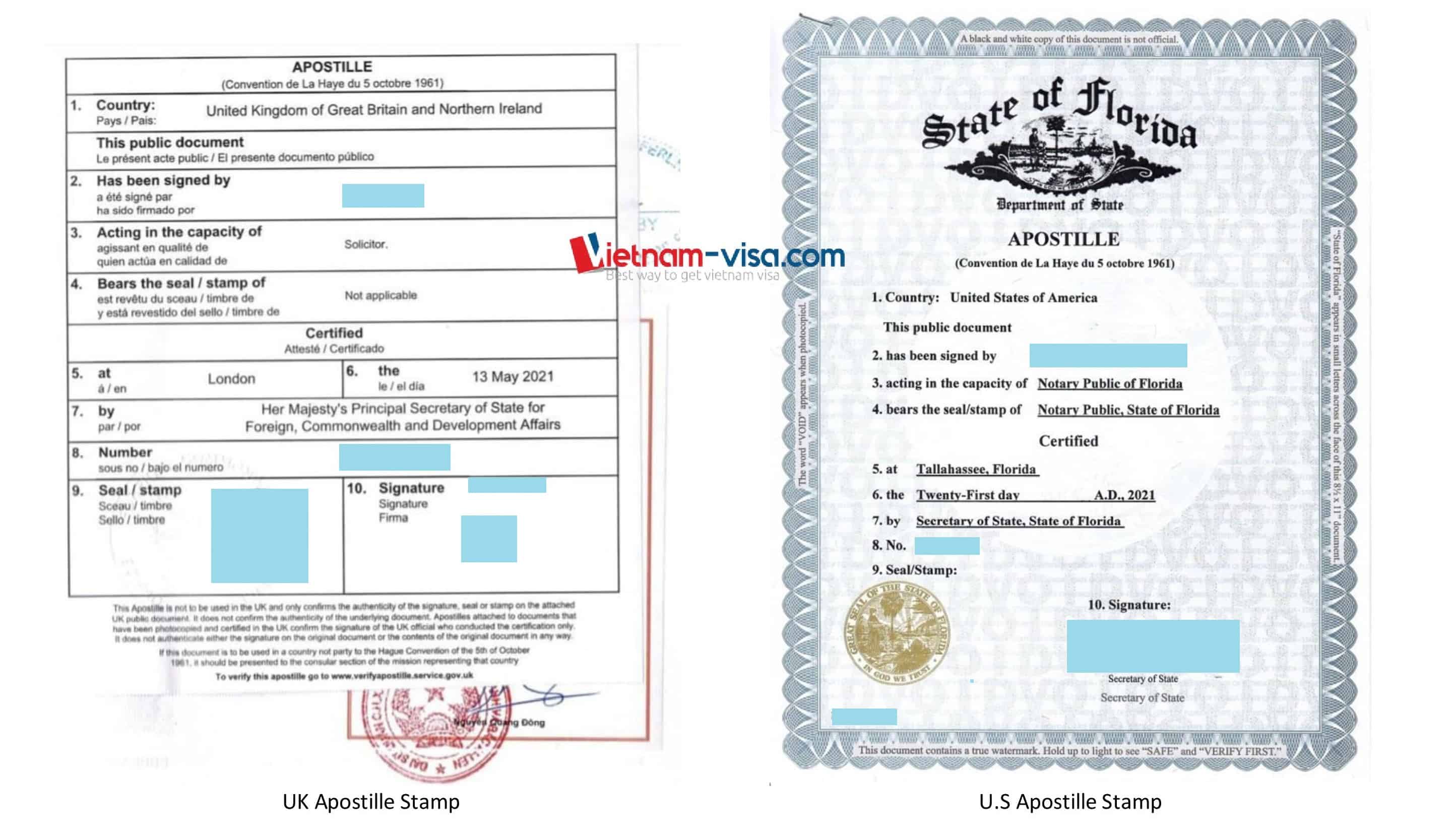
How does an Apostille stamp look?
An Apostille stamp (certificate) is normally a square and formatted into numbered fields. It is often stamped on the back of a document. However, when a document has print on both sides, it may be placed in the most suitable position, which may be on the front.
A typical Apostille certificate shows the following information:
- Country of issue
- Name of person who signed the document
- The capacity in which the person signed the document
- Details of any seal on the document
- Place of issue of Apostille certificate
- Date of issue
- Issuing authority
- Apostille Certificate number
- Stamp of issuing authority
- Signature of representative of issuing authority
List of Hague Convention Apostille countries
As last updated on the website of The Hague Conference on Private International Law (HCCH), there are, up to now, up to 129 contracting countries to the Apostille Convention (Hague Treaty Convention) as follows:
| Albania Algeria Andorra Antigua and Barbuda Argentina Armenia Australia Austria Azerbaijan Bahamas Bahrain Bangladesh Barbados Belarus Belgium Belize Bolivia Bosnia and Herzegovina Botswana Brazil Brunei Darussalam Bulgaria Burundi Cabo Verde Canada Chile China, People’s Republic of (Hong Kong & Macao Only) Colombia Cook Islands Costa Rica Croatia Cyprus Czech Republic Denmark Dominica Dominican Republic Ecuador El Salvador Estonia Eswatini (Swaziland) Fiji Finland France Georgia | Germany Greece Grenada Guatemala Guyana Honduras Hungary Iceland India Ireland Israel Italy Jamaica Japan Kazakhstan Korea (Republic of Korea) Kosovo Kyrgyzstan Latvia Lesotho Liberia Liechtenstein Lithuania Luxembourg Malawi Malta Marshall Islands Mauritius Mexico Republic of Moldova Monaco Mongolia Montenegro Morocco Namibia Netherlands New Zealand Nicaragua Niue Republic of North Macedonia Norway Oman Pakistan | Palau Panama Paraguay Peru Philippines Poland Portugal Romania Russian Federation Rwanda Saint Kitts and Nevis Saint Lucia Saint Vincent and the Grenadines Samoa San Marino Sao Tome and Principe Saudi Arabia Senegal Serbia Seychelles Singapore Slovakia Slovenia South Africa Spain Suriname Sweden Switzerland Tajikistan Thailand Tonga Trinidad and Tobago Tunisia Turkey Ukraine United Kingdom of Great Britain and Northern Ireland United States of America Uruguay Uzbekistan Vanuatu Venezuela Vietnam |
Who can issue an Apostille?
In most cases, the competent authority which can issue an apostille stamp is the Ministry of Foreign Affairs of the document’s issuing country.
Which documents are eligible for an Apostille certificate?
According to The Hague Convention 1961, an Apostille stamp is issued for public documents of Apostille countries which are:
| Document group | Common examples |
| Civil status | Birth certificates, marriage certificates, nationality and adoption documents |
| Judicial and enforcement | Court judgments and decisions, procedural documents, criminal record certificates and specified enforcement documents |
| Education | Degrees, diplomas, certificates and official records of study or research results |
| Health | Health certificates, medical certificates and medical assessment conclusions |
| Notarial documents | Notarized contracts and transactions, notarized translations and notarized copies |
| Certified documents | Certified copies, certified signatures, certified translator signatures and certified contracts or transactions |
| Other official records | Documents issued or certified by a competent Vietnamese authority while exercising its legal functions |
❗ Examples of documents not automatically considered public documents: private contracts signed between parties, invitation letters, explanatory letters, CVs, pay slips, or documents prepared by individuals/enterprises that have not been notarized, certified, or legally authenticated. Determination must be made on a case-by-case basis.
👉 Contact us for review via Hotline/WhatsApp: (US)+1.341.999.4099 | (VN)+84.387.285.099
2. Is Apostille valid in Vietnam?
Yes – from September 11, 2026, a valid Apostille is recognized in Vietnam for an eligible public document issued by a Contracting Party where the Convention applies in relation to Vietnam.
Under Decree 293/2026/ND-CP, that document is exempt from consular legalization in Vietnam. A Vietnamese authority should not require an additional consular certification or legalization step solely to authenticate a valid Apostille.
However, acceptance still depends on all of the following:
- The document is a public document under the law of the place where it was issued.
- The Apostille was issued by the competent authority of that country or territory.
- The Convention applies between that country and Vietnam on the date the document is used.
- The certificate follows the Convention model and has not been revoked or cancelled.
- The document meets Vietnamese translation and subject-specific requirements.
3. How to use a foreign Apostilled document in Vietnam
Follow this decision process for a public document issued outside Vietnam:
- Confirm that the document is a public document under the law of the issuing country or territory.
- Check the HCCH status table to confirm that the Convention applies between the issuing country and Vietnam.
- Obtain the Apostille from the competent authority in the country or territory where the document was issued.
- If the document is not in Vietnamese, it must be translated into Vietnamese, and the translation must be notarized or certified, unless otherwise provided by specialized laws.
- Submit the document, Apostille and translation to the receiving authority. Comply with any additional substantive requirements for the relevant purpose, such as employment, education, marriage, investment or immigration.
Do you still need the Vietnamese embassy or consulate?
Not for the authentication of an eligible public document that already carries a valid Apostille from an applicable Contracting Party. The receiving authority may still request translations or documents required by specialized law, but it should not require an additional consular legalization step for the Apostille itself.
4. How long does Apostille take in Vietnam?
Standard processing takes 01 – 04 working days, depending on the number of documents; verification time, if required, is not included in the above timeframe.
| Submission method | Quantity | Statutory processing time |
| Paper: direct or postal | 1-4 documents | 1 working day |
| Paper: direct or postal | 5-9 documents | 2 working days |
| Paper: direct or postal | 10 or more documents | 4 working days |
| Fully online: eligible electronic documents | 1-4 documents | Within the working day if received before the official cut-off; otherwise counted from the next working day |
| Fully online: eligible electronic documents | 5-9 documents | 1 working day |
| Fully online: eligible electronic documents | 10 or more documents | 3 working days |
*Verification time is not included. If the issuing authority, signature, seal, title or circulation status must be verified, the application may take longer.
5. How much does Apostille cost in Vietnam?
The applicant must pay the prescribed certification/legalization fee at the time of filing. Postal charges apply when results are sent by post. Because fee schedules and service charges may change, check the official filing portal or competent authority before publishing or quoting an amount.
6. What is legalization?
As also defined in the Hague convention 1961, legalization means the formality by which the diplomatic or consular agents of the country in which the document has to be produced certify the authenticity of the signature, the capacity in which the person signing the document has acted and, where appropriate, the identity of the seal or stamp which it bears.
For documents to be used in Vietnam, the authority competent for a Vietnam consular legalization can be:
- the Ministry of Foreign Affairs of Vietnam, or
- Embassy/Consulate of Socialist Republic of Vietnam in foreign countries.
The legalization often follows the step of authentication of documents by the competent authority of the issuing country unless the involved documents are exempted from the authentication step. And it is the required process for non-public documents of Apostille countries or all documents of non-Apostille countries.
👉 Learn more about Consular Legalization in Vietnam here.
7. Difference Between the Apostille and Legalization
“Is Apostille the same as Legalization?” is the most frequently asked question when it comes to those terms.
Normally, they are the same in purposes of use. However, they are completely different in terms of applicable countries and documents, and procedures of which the legalization is much more complicated.
| Criterion | Apostille | Consular legalization |
| When used | Eligible public documents between Vietnam and a country where the Convention applies | Documents outside the Apostille route, including non-applicable country relationships |
| Main authentication | One Apostille issued by the competent authority of the issuing country | Domestic authentication plus legalization by the destination country’s diplomatic/consular authority, as required |
| Vietnam embassy step | Not required for an eligible foreign public document with a valid Apostille | May be required under the traditional route |
| Document content | Not certified | Not certified merely by legalization |
| Translation | May still be required | May still be required |
| Country check | Must confirm the Convention applies in relation to Vietnam | Used when the Apostille route is unavailable or outside scope |
👉 Check How to legalize documents for Vietnam
Need help choosing the correct document route?
Before requesting a quotation or starting the process, prepare these four details:
- country or territory where the document was issued;
- country where the document will be used;
- document type and whether it has been notarized or certified; and
- purpose of use and the name of the receiving authority.
Vietnam-visa.com can review the information provided and help identify whether the likely route is Apostille, consular legalization or a possible exemption. Final acceptance remains subject to the competent issuing and receiving authorities.
👉 Feel free to send us your documents for review to:
- Hotline/WhatsApp: (US)+1.341.999.4099 | (VN)+84.387.285.099
- Email: [email protected]